Estimated reading time: 7 minutes
Key Takeaways
- A culture of accountability in a preschool means every role owns its outcomes and follows through, answerable to each other and to parents, without a blame culture.
- The habits that erode it are small and quiet: vague roles, invisible expectations, “I thought someone else had it,” and verbal-only handoffs. They compound as you add classrooms and branches.
- Clarity comes first. An all-in-one preschool management solution makes each person’s tasks, deadlines and ownership visible, which is where accountability actually starts.
- Preschool ERP software builds follow-through with owned tasks, gentle reminders, status visibility and recognition, so leaders can coach on patterns instead of policing people.
- The software is the easy half. Setting expectations, modeling ownership, holding blameless reviews and recognizing reliability is leadership work no tool can do for you.
- A durable culture of accountability is what turns steady operations and consistent quality across branches into institutional excellence.
A parent walks up to your front desk. She asks, politely, why nobody called her back about the admission inquiry she left last week. The front desk assumed the lead teacher was following up. The lead teacher assumed admin owned it. Admin assumed you, the owner, had already handled it.
Nothing malicious happened. The task simply had no owner, and it fell through a gap that gets a little wider every time you add a class or open a branch.
Here is the part most guides skip. That dropped follow-up is not a people problem. It is a clarity problem, and clarity at work is getting worse. Gallup reports that knowing what is expected has fallen nine percentage points among employees since 2020, the largest decline of any engagement element it measures. Employees who do have clear expectations are nearly four times as likely to be engaged. When people cannot see the finish line, they cannot own crossing it.
A preschool that scales without a culture of accountability ends up firefighting. The schools that hold their quality as they grow have built something else: a culture of accountability where every role owns its outcomes and follows through, and where people are answerable to each other and to parents without fear of blame.
Now the argument this whole post defends. Preschool ERP software will not hand you that culture. It makes the culture you decide to lead visible and repeatable. Buy it expecting the software to build ownership by itself, and you will just automate the same finger-pointing, faster.
What follows is a practical playbook for owners and principals. We will cover what accountability really means inside a preschool, the everyday habits that quietly erode it, and how an all-in-one preschool management solution carries role clarity, follow-through and recognition as your school grows.
Table of contents
- A culture of accountability is answerable without blame, and that is a choice
- Accountability rarely collapses loudly, it leaks through small dropped handoffs
- Shared ownership starts with clarity on one screen
- Preschool ERP software builds habits by closing the loop
- The software is the easy half, holding the culture is the hard part
- A culture that follows through turns growth into institutional excellence
A culture of accountability is answerable without blame, and that is a choice, not a setting
Let us be concrete about what we mean. A culture of accountability in a preschool is a shared norm where every role, the owner, the admin, the lead teacher, the assistant, the front desk, owns its outcomes and follows through. People are answerable to each other and to the parents they serve, and when something slips, they can say so without fear of being blamed. It lives in people, habits and expectations. It does not live in paperwork.
This is different from oversight or control. Oversight asks a backward-looking question: can we prove who did what? Culture asks a forward one: does each person own their work and follow through because that is simply how this school runs? A school can pass every check on paper and still have a team where nobody feels responsible for anything. This post is about the second thing.
Here is the worry many owners carry. If I raise the standard, will my team feel policed and anxious? They do not have to. Amy Edmondson’s research describes a learning zone that pairs high accountability with high psychological safety, where people admit mistakes and give honest feedback precisely because the standards are high. Pair high accountability with low safety instead, and you get an anxiety-and-blame zone where people hide problems.
For a preschool, the healthy version sounds like this. A teacher says, I forgot to log that incident today. Here is how I will make sure it does not happen again. That sentence is the sound of a culture working.
Software gives you the visibility to make ownership clear. Whether that visibility feels like coaching or like surveillance is set by the leader, not by the tool. Good preschool management software puts the facts on one screen. What you do with them is a leadership decision.
Read More: The Strategic Role of Preschool ERP Software in Driving Institutional Excellence
Accountability rarely collapses loudly, it leaks through small dropped handoffs
Accountability almost never fails in a dramatic moment. It leaks, slowly, through small habits that feel harmless one at a time. Watch for these:
- Vague role boundaries. Two people both assume the other owns admissions follow-up, so neither does.
- Invisible expectations. “Keep parents updated” is understood five different ways by five different staff members.
- “I thought someone else was handling it.” The single most expensive sentence in a growing school.
- Dropped follow-ups. A fee reminder never sent. A callback never made. An incident logged only in someone’s memory.
- Verbal-only handoffs. A quick word at shift change that leaves no trace by the next morning.
- Finger-pointing. When something slips and the reflex is to find fault, staff learn to protect themselves instead of owning the miss.
When you run one small center, none of this is fatal. You personally see almost every task, so gaps get caught by your own eyes. Then you add a second branch, a third classroom, a few more staff, and that direct line of sight disappears. The habits that were harmless at ten children become structural at a hundred. This is the moment most schools start firefighting.
None of this is unique to preschools. Gallup finds that clarity of expectations has fallen faster than any other engagement element, and that fewer than a third of leaders can even state clearly what excellent performance looks like. If leaders cannot define the finish line, staff cannot own crossing it. The fix is not a lecture about caring more. It is making the invisible visible.
Shared ownership starts with clarity, and an all-in-one preschool management solution puts it on one screen
Accountability starts with clarity, not blame. Before you can hold anyone to a task, that person has to know the task is theirs. This is where the tooling earns its place. An all-in-one preschool management solution makes each person’s responsibilities, tasks and deadlines explicit and visible, instead of leaving them to live in someone’s head.
Picture the difference:
- Admissions follow-up assigned to a named person with a due date, not handed vaguely to “the team.”
- Fee reminders owned by the front desk, scheduled and visible, so no parent quietly slips through.
- Incident logging owned by the lead teacher, entered the same day, visible to the owner.
- Daily parent updates owned per classroom, so every family hears from a specific someone.
Peter Bregman, writing in Forbes, is blunt about what accountability actually is. It is about delivering on a commitment, not about taking the blame when something goes wrong. It holds only when a leader gets clear in five linked areas: clear expectations, clear capability (the skills and resources to do the job), clear measurement (agreed milestones), clear feedback (people should always know where they stand), and clear consequences. Miss any one of the five, and accountability breaks down.
Notice which two of those five a system is strongest on. Expectations and measurement. Good preschool management software can make “who owns what” and “is it done yet” visible to everyone at a glance. The other three, capability, feedback and consequences, are still yours to supply.
That is the concrete decision at the heart of this post. The tool makes ownership visible. It does not decide who should own what, and it cannot judge whether that person has the skills and time to deliver. Assigning ownership well is a leadership act, and it has to happen before the software can help you. Pair it with your communication tools so daily parent updates have a clear owner too.
Preschool ERP software builds habits by closing the loop, gently and on repeat
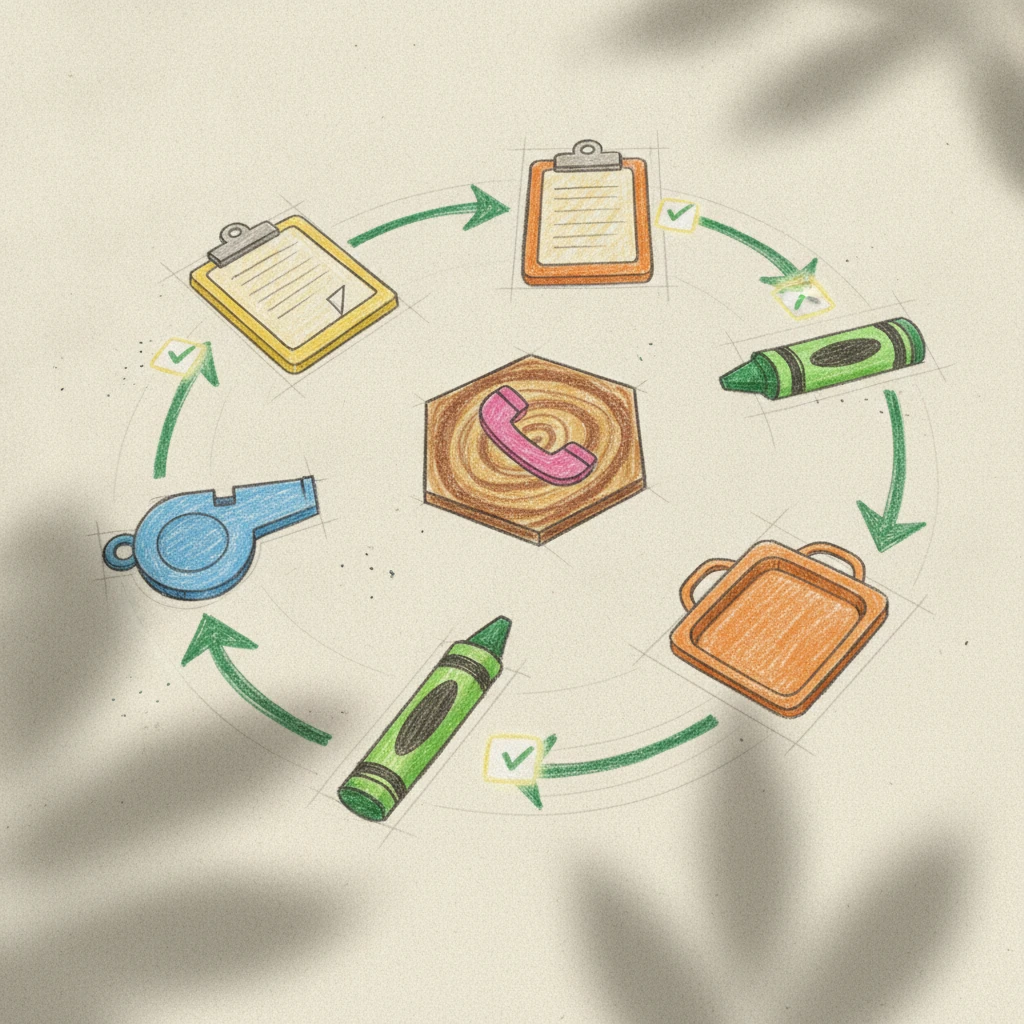
Good intentions rarely fail because people stop caring. They fail because there is no loop that turns “I meant to” into “it got done.” Preschool ERP software creates that loop. Task ownership, automatic reminders, status visibility, shared dashboards, and recognition when someone follows through reliably. The reminders are gentle and automatic, so following up stops depending on anyone’s memory or mood on a hard day.
Reliable habits come from a repeating loop, not a one-time push. The Plan-Do-Study-Act cycle works for exactly this reason: you check whether the plan worked, fold what you learned back in, and run it again. A shared dashboard is a small version of the same idea. See the pattern, adjust, repeat.
Here is the payoff that most owners underrate. When status is visible to everyone, you can coach on patterns instead of policing individuals. Not you forgot again, but our afternoon incident logs are always late. What is getting in the way at pickup time? That question moves the conversation from the person to the process. It is the same blameless-but-answerable tone we described earlier, and it is far more likely to actually fix the problem.
Same data, opposite cultures. The dashboard shows the pattern either way. Whether you use it to blame a person or to repair a process is your choice, not the software’s. A shared learning and management system only shows you the picture. You decide what the picture means.
Read More: Building Transparent and Accountable School Administration with Preschool ERP Software
The software is the easy half, holding the culture is the part leaders rate themselves worst at
Installing the system takes a weekend. Building the culture takes leadership every single week. And leadership is the hard half.
We do not have to guess about this. Leaders themselves rate “create accountability,” meaning holding everyone responsible for excellent performance, as their single weakest competency. Fewer than half call themselves outstanding at it. Yet where managers say their leader does excel at accountability, they are about three times as likely to be engaged, 51 percent versus 17 percent. The tool does not close that gap. You do.
Here is the work, stated as concrete actions:
- Set visible expectations. Put what “good” looks like into the system as owned tasks and clear standards, not as a memo nobody reopens.
- Model ownership yourself. When you drop a ball, say so first, out loud. Staff copy what the owner does, not what the handbook says.
- Hold blameless review conversations. When something slips, ask what in the process let it slip, using the shared data, before you ask who slipped.
- Recognize reliability out loud. Celebrate the assistant who logs every incident on time. What gets recognized gets repeated.
- Use shared data for honest, forward-looking talks. Run the same conversation across one branch or a whole chain, so every location holds the same standard.
Every one of these steps uses the software. Not one of them is done by the software. That is the entire argument in miniature. For owners running several sites, multi-branch admin tools let you carry the same expectations to every location, but the carrying still starts with you deciding what the standard is.
A culture that follows through is what turns a growing preschool into institutional excellence
When accountability holds as a habit, good things stack up. Operations get steadier because tasks stop falling through gaps. Teams stay calmer because nobody is bracing for blame. Parents trust a school that always follows through. And quality stays consistent from your first classroom to your fifth branch.
That consistency is what institutional excellence actually is. Not a great day now and then, but a reliable one, repeated at scale.
Read More: How Data-Driven Preschool Management Is Improving Early Childhood Education Standards
This link is measurable, not a feel-good claim. In Gallup’s 11th-edition meta-analysis of 736 studies covering more than 183,000 work units and 3.3 million employees across 90 countries, business units in the top quartile of engagement outperform the bottom quartile by 23 percent in profitability, 18 percent in productivity and 32 percent in quality, with far fewer defects. Top-half units more than double their odds of success on a combined measure of financial, customer, quality and retention results. Accountable teams are calmer places to work. They also post better numbers.
So here is the recommendation, plainly. Buy the all-in-one preschool management solution for what it genuinely does: it is the shared place where expectations stay visible, ownership stays assigned, and follow-through stays tracked when you can no longer see every task in person. Then carry the culture yourself. Lead the accountability. A tool cannot own an outcome. A person has to. The software just makes sure the right person can see that the outcome is theirs, and that is exactly what keeps a culture of accountability alive as your school grows toward institutional excellence.
FAQ
No. It makes ownership and follow-through visible and repeatable, but the expectations, coaching and recognition that make people answerable are leadership work. Buy it to support the culture, not to replace the leading.
Blame looks backward to find who is at fault. Accountability looks at whether each person owns and delivers on their commitments. Healthy accountability lets staff admit a miss and fix it without fear, which is why high standards and psychological safety belong together.
People can only own what they know is theirs. When admissions follow-up, fee reminders and incident logging are assigned to named people with deadlines inside the system, “I thought someone else had it” stops happening.
Once the owner cannot personally see every task, shared dashboards and owned tasks keep every branch running to the same standard. They also let leaders have honest, forward-looking conversations using the same data at every location.
Yes. Gallup’s meta-analysis links top-quartile engagement to 23 percent higher profitability, 18 percent higher productivity and 32 percent fewer quality defects. Consistent accountability shows up in steadier operations and stronger institutional excellence.
Related posts

- October 19, 2026
- 10:01 am
Preschool Management Software: What Should You Actually Look For Before Buying?

- October 14, 2026
- 11:56 am
The Preschool Automation Opportunities Hidden in Everyday Administration
- October 12, 2026
- 3:41 pm
