Estimated reading time: 9 minutes
Key Takeaways
- The costly problem in preschool management is rarely missing data. It is the lag between a signal appearing and a decision acting on it.
- That lag is a clock. Every slow day raises your Days Sales Outstanding, cools an admissions enquiry, and leaves a seat empty another month.
- Fragmented tools, meaning spreadsheets, WhatsApp threads, paper, and disconnected apps, stretch the lag because the signal scatters and no single role owns the next step.
- A real-time preschool management system collapses the lag: one connected record surfaces the issue the same day, and role-based routing puts the decision in front of the right person.
- Speed has to be built into the system, not carried by one heroic administrator, or it leaves when that person does.
It is Friday afternoon. You run three branches, and you have finally opened the fee register. There it is: a family stopped paying six weeks ago. The number was sitting in the file the whole time. Nobody acted on it.
The costliest decision delays in preschool management are rarely caused by missing information. The information usually exists. What is missing is the person, the moment, and the trigger to act on it. That gap, repeated across fees, staffing, and admissions, is the real bill you pay every month.
Most owners think they have a visibility problem. More often they have a speed problem. Buying more dashboards without faster routing just documents the delay in higher resolution. You end up with a prettier record of the same slow week.
The position is simple. In a preschool, the expensive problem is almost never a shortage of facts. It is the delay between the moment a signal appears and the moment someone acts on it. So buy for decision speed, not for another report.
The cost compounds through four mechanisms, and we will walk each one: leaked fees and a rising Days Sales Outstanding, admissions lost to slow response, occupancy left unfilled, and staff time burned firefighting. Then we will show the fix. A connected, real-time system turns we found out next month into we acted today. This is a supporting piece in a wider BubbleBud Kids series on what well-managed preschools get right, and speed is the part most guides skip.
Read More: What Well-Managed Preschools Get Right with Preschool Management Software
Why a decision delay, not missing data, is the tax you keep paying
Let’s define the term precisely. A decision delay is the time between a signal appearing and someone acting on it. The signal might be an unpaid fee, an absent teacher, a fresh admissions enquiry, or a dip in daily attendance. The delay measures speed. It is separate from two things people often confuse it with.
Think of two different axes. Decision quality asks: was it the right call? Decision speed asks: how long did it take to make and carry out? Good preschool decision-making needs both. But schools obsess over quality and quietly ignore speed, and speed is where the money leaks.
Owning a number is not the same as acting on it. Across the wider economy, firms that actually adopt data-driven habits show output and productivity about 5 to 6 percent higher than their technology spending alone would predict. That comes from a 2011 study of 179 large firms, and it holds a plain lesson for a preschool: the value was never in holding the number. It was in acting on it. That is what separates firms that put the data they already hold to work from firms that merely collect it. Treat that as general business economics, not a school benchmark. The mechanism travels well all the same.
Now picture the lag in an ordinary week. Each example pairs a signal with the action that arrived too late.
- Fee signal: a parent’s payment fails on the 5th. The reminder goes out on the 25th.
- Staffing signal: a teacher calls in sick at 7am. Cover is scrambled at 8:45am, with parents already at the gate.
- Admissions signal: an enquiry lands on Saturday night. The callback happens Wednesday, after the parent has toured two other schools.
- Occupancy signal: nursery attendance drifts down for three weeks before anyone spots the trend.
In each case the fact existed. The clock kept running. So the question to ask of any tool is not does it store this? It is how many days pass before it makes someone act?
Where the delays hide when your school runs on spreadsheets and WhatsApp
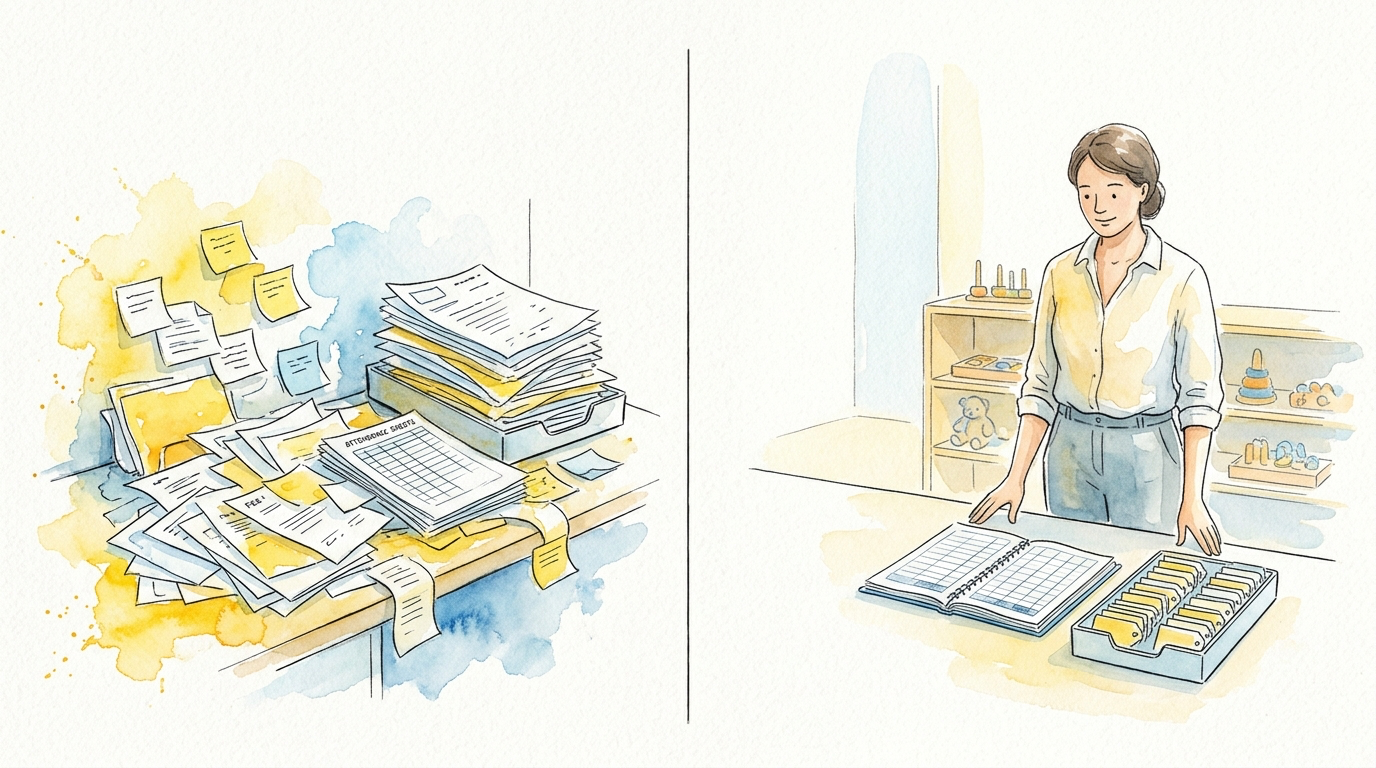
Look at where your signals actually live. Fee data sits in one spreadsheet. Attendance is on paper. Parent messages are buried in WhatsApp threads. Admissions enquiries are in a shared inbox, or a notebook by the phone. Staff leave is tracked in a fourth app. The signal exists, but it is scattered across five places, and no single role clearly owns the next step.
This is the heart of the problem. When a signal lives in a channel nobody is accountable for, it waits. A WhatsApp message about a fee problem gets seen by three people and owned by none. The delay is not laziness. It is missing ownership, and fragmentation guarantees it.
The tools themselves make it worse. About 94 percent of business spreadsheets used in decision-making carry errors, according to research reported in 2024. So the school is not only slow to act on the signal. When it finally does act, it is often working from a wrong number. Read that as a general business finding, but the risk is easy to picture: spreadsheets used for real decisions are riddled with mistakes, and every handoff adds another chance to copy the error forward.
There is a name for this in the wider BubbleBud Kids series: hidden coordination work. Every handoff between a spreadsheet, a chat thread, and a paper form is unpaid coordination labor, and it adds days to the clock. You do not see it on any invoice. You feel it in the hours your team loses.
The contrast is simple. A single preschool management system keeps fees, attendance, admissions, and staffing on one connected record. The signal then has exactly one place to live and one owner to route it to. That is the difference between a school that reacts in hours and one that reacts in weeks.
Read More: The Preschool Management Signals That Tell Owners Their School Is Truly Organized
What each day of delay actually costs, mechanism by mechanism
Let’s price it out, one mechanism at a time. No invented preschool figures. Just the levers you can track for yourself.
Fee leakage and a rising DSO
Days Sales Outstanding is the average number of days it takes your billed revenue to turn into cash in the bank. When fee follow-up is slow, that number climbs. And a metric called Days Sales Outstanding rising over time is a clear sign a business is struggling to convert what it has billed into cash it can actually spend on salaries and rent. For a small operation that lives on quick receivables, that is a direct squeeze. Track your own DSO month over month. It is the cleanest single measure of how fast your fee decisions really happen.
Admissions lost to slow response
A preschool seat is not a one-off sale. It is a recurring revenue relationship, often several years long. So losing one enquiry is not a small miss. Consider the retention economics that hold across industries: acquiring a new customer costs roughly five to 25 times more than keeping an existing one, and lifting retention by 5 percent can raise profits by 25 to 95 percent. That framing comes from Bain research written up in 2014, and it is the economics of keeping a customer versus winning a new one. Treat it as general business economics, not a preschool benchmark. The point still lands: a family that drifts because the callback was slow costs far more to replace than to have kept. Admissions also run on word of mouth, so a dropped enquiry can quietly cost you referrals too.
Occupancy left unfilled
A seat empty this month is revenue you never bill and never recover. Unlike a late fee, you cannot chase it later. The month is simply gone. When an occupancy dip stays invisible until the term report, the correction, a marketing push or a waitlist call, arrives a month too late. Track occupancy rate by level, and review it weekly, not once a term.
Staff time burned firefighting
Every delayed signal eventually becomes an emergency, and emergencies are the most expensive way to spend an administrator’s day. Re-checking numbers across five tools, reconstructing what happened, reacting under pressure: those hours never reach a child or a parent. This is the morale half of the cost. Your best people spend their week putting out fires instead of building the school.
Each of these is a clock problem. And a connected preschool ERP software setup exists for one reason: to reset the clock before the cost lands.
How real-time preschool management collapses the lag from weeks to hours
Now apply the position to the fix. This part is argued by design, not by a statistic.
Start with one connected record. When fees, attendance, admissions, and staffing all share one system, a failed payment, a no-show, or a cooling enquiry shows up on a live view the day it happens, not at month-end. That is what real-time preschool management buys you. Not more data. Faster sight of the data you already generate. In plain terms, the school’s current state is visible right now, rather than reconstructed weeks later.
Then add role-based routing. Role-based access means each signal is automatically the responsibility of a defined role. The branch head sees her branch’s fee misses. The admissions lead sees new enquiries. The center manager sees staffing gaps. Ownership is assigned by the system itself, so the no one owns the next step failure disappears. Nobody has to remember to forward anything. The signal arrives already addressed.
The result is a shorter clock. We found out next month becomes we acted today. And that speed is the whole win. It recovers the leaked fee while the family is still enrolled. It saves the wavering parent while they are still deciding. It fills the seat while it can still be filled.
This is what a connected preschool management software suite is actually for. It is why more owners now frame the purchase as buying decision speed rather than buying a longer feature list. Features are easy to compare. Speed is what changes your week.
One honest caveat. Real-time visibility only helps if someone is set up to act on it. A live view that nobody is assigned to watch is just a faster way to miss the same signal. Which brings us to the last piece.
Read More: The Hidden Business Benefits of Modern Preschool Management Software
Make fast decisions a system, not a heroic administrator
One trap is worth naming. In many schools, fast decisions already happen, but only because one exceptional administrator holds the whole operation in her head. She knows who to chase, when the fees are due, which teacher covers which room. That is heroism, not a system. And it is fragile.
Employee turnover is one of the most reported causes of knowledge loss in any organization. When the person who just knew what to do leaves, the routines that made the school responsive walk out with her. The damage is worse in small organizations, and worse still when the person who goes was the critical one. You do not just lose a staff member. You lose the school’s reflexes.
The fix is to standardize ownership. Define who decides what, and by when, so the routing survives staff changes and multi-branch growth. This moves the school away from reactive, once-a-term look-backs toward an ongoing, same-day cycle of noticing and acting. The point is not more meetings. It is a steady rhythm of catching signals and clearing them while they are small.
A preschool management system is what makes that routine durable. The roles, the triggers, and the escalation paths live in the software, not in one person’s memory. So a new branch or a new hire inherits the same speed on day one. Good preschool decision-making stops being a personal talent and becomes a property of the school.
This is part of what well-managed preschools get right. It is why the wider BubbleBud Kids series treats consistent, system-held routines as a sign of a school that has grown up operationally, rather than one that is holding on by luck and one heroic person.
Measure your own decision lag this week
Try one concrete self-check. Pull your last three fee misses, your last three admissions enquiries, and your last unplanned staff absence. For each, write down two dates: when the signal first existed, and when someone acted on it. The gap between those two dates is your decision lag. That number, not your feature list, is your real operating cost.
So here is the recommendation. Stop shopping for more visibility. Start shopping for shorter lag. The right question for any preschool tool is not how much it can show you. It is how many days it removes between a signal and an action.
If the honest answer to your self-check is too many days, a connected, real-time setup is worth a real conversation. The team at BubbleBud Kids is happy to talk through where your school is losing time and how to close the gap. You can reach us at connect@bubblebudkids.com or through the contact page whenever you want to compare notes.
FAQ
It is the time between a signal appearing, such as an unpaid fee, an absent teacher, or a new admissions enquiry, and someone actually acting on it. It is a measure of speed. It is separate from whether the eventual decision was the right one.
Usually the data already exists somewhere, in a spreadsheet or a WhatsApp thread. The cost comes from how long it sits before anyone acts. That is a speed problem, not a data-availability problem.
It keeps fees, attendance, admissions, and staffing on one connected record, so signals surface the same day. It also routes each signal to a defined role, so someone always owns the next step.
It means the school’s current state is visible now, rather than reconstructed at month-end. You see a fee miss or an occupancy dip the day it happens instead of weeks later.
For your recent fee misses, admissions enquiries, and staff absences, record the date the signal appeared and the date someone acted. The average gap is your decision lag. Tracking your DSO and your weekly occupancy makes the cost concrete.
Related posts

- October 9, 2026
- 5:40 am
Why Preschool Administration Becomes Complex When Every Process Runs Separately

- October 5, 2026
- 5:37 am
From Admissions to Administration: Building a Connected Preschool Operations System

- September 30, 2026
- 10:48 am
