Estimated reading time: 9 minutes
Key Takeaways
- Operational maturity means repeatable operations that survive staff changes, not owner heroics.
- Real-time visibility drives efficiency by catching small errors the day they happen, not weeks later.
- Consolidate tools into one shared record instead of collecting more disconnected apps and spreadsheets.
- Decide on self-tracked KPIs like occupancy and Days Sales Outstanding, each with a clearly named owner.
- Run the six-question self-check and improve in small, repeating Plan-Do-Study-Act loops.
It is 6 p.m. on a Friday. The children have gone home, the corridors were calm all week, and the owner is still at her desk. She is matching fee receipts against a paper notebook and three WhatsApp chats, trying to work out who actually paid this month. Nothing is on fire. And that is exactly the problem.
A preschool that runs fine because one person holds it together in her head is not the same as a preschool that runs well on its own. That gap is what separates operationally mature preschools from schools that are simply busy or simply quiet. The busiest, most hands-on school in your area is often the least mature of all, because everything depends on heroics instead of systems.
This post is not a feature list and not a sales pitch. It is a maturity lens, plus a short self-check you can run this week to see where your own school actually sits.
This is the part most how to grow your preschool advice skips.
What operationally mature preschools actually do differently
Maturity is a simple idea. It is how consistent and repeatable your operations are, no matter who is on shift. A mature school does the same thing the same way whether the senior teacher is present or home with the flu.
That idea did not start in education. It comes from the Capability Maturity Model, which ranks organizations from ad hoc and chaotic, held together by individual heroics at the very bottom, up through repeatable and written-down processes, to operations that are measured and improved on purpose. Picture that ladder in preschool terms:
- Bottom rung: every task lives in someone’s head. If they are away, it does not happen right.
- Middle: the school has routines it can repeat, and they are written down.
- Top: the school tracks how well those routines work and makes them better.
Here is the point most people get backwards. Heroics sit at the bottom of that ladder, not the top. The owner reconciling fees at 6 p.m. is not proof of a great operation. It is proof the operation cannot do that one job without her.
So what maturity is not: it is not being busy. It is not calm-looking corridors. It is not being big, and it is not luck. A small two-classroom school can be far more mature than a five-branch chain. This is one piece of what well-managed preschools get right, the difference between a school that survives each day and one that runs with calm, repeatable operations. Operationally mature preschools have simply moved the work out of one person’s memory and into the school itself.
Their processes belong to the school, not to the person doing them
A mature school treats a process like property the school owns. Not a habit that lives in one employee.
Think about what that means in practice. The admissions steps, the daily attendance routine, the fee-reminder schedule, the incident-report format: all written down as plain, simple steps, and all sitting in one shared record that anyone with the right role can open.
Why does this matter so much? When a staff member leaves, a school loses more than a pair of hands. It loses the routines and the quiet know-how that person carried in her head. The she just knew which parents to call first knowledge. Studies of staff departures describe this as damage to a company’s memory and a real disruption to its routines. The fix they point to is a shift in thinking, away from replacing the person and toward keeping the knowledge. A mature preschool has already done that. The knowledge was written down before anyone left.
Compare the two schools when a head teacher resigns.
- The fragile school stalls. Admissions freeze for three weeks because nobody else knew the follow-up sequence.
- The mature school does not blink. The next person opens the shared record and carries on the same afternoon.
This is management that outlives any single employee. The school keeps its shape even when the people change. If your school would struggle after one resignation, that is not a staffing problem. It is a maturity problem.
They run on real-time visibility, and that is where preschool operational efficiency comes from
A mature school can see what is happening today. Admissions in progress, who is present, which fees are due, how full each room is, all visible now, without waiting for someone to sit down and compile it. That live view is the engine of preschool operational efficiency.
Define that efficiency by mechanism, not by slogans. Efficiency here means fewer errors and less rework. When you see a missed fee on the day it is missed, you send one reminder and you are done. When you find that same missed fee six weeks later during a reconciliation, you have to chase it, fix the records, and you might have lost the money for good. Same problem. Very different cost.
There is a hard reason to distrust hand-kept records. Research auditing business spreadsheets found that the overwhelming majority contained critical errors, and those errors lead to poor decisions, financial losses and pricing mistakes. Most of the checking happens only after the sheet is already built, and already wrong. Apply that to your fee register. A sheet that is far more likely than not to hide an error is not a source of truth. It is a source of Friday-evening reconciliation.
Here is what a mature school watches in near real time:
- Attendance patterns. A child quietly absent for a week is an early signal, not a month-end surprise.
- Fee status. Who has paid and who is overdue, today, not in a fortnight.
- Occupancy per classroom. An empty seat is lost revenue, and you can only fill it if you can see it.
A calm day is not the absence of coordination work. It is coordination work that has been made visible and shared, instead of carried in silence by one exhausted person. Efficiency is not working faster. It is catching the small thing before it grows into the expensive thing.
Read More: What Well-Managed Preschools Get Right with Preschool Management Software
They consolidate their tools instead of collecting more of them
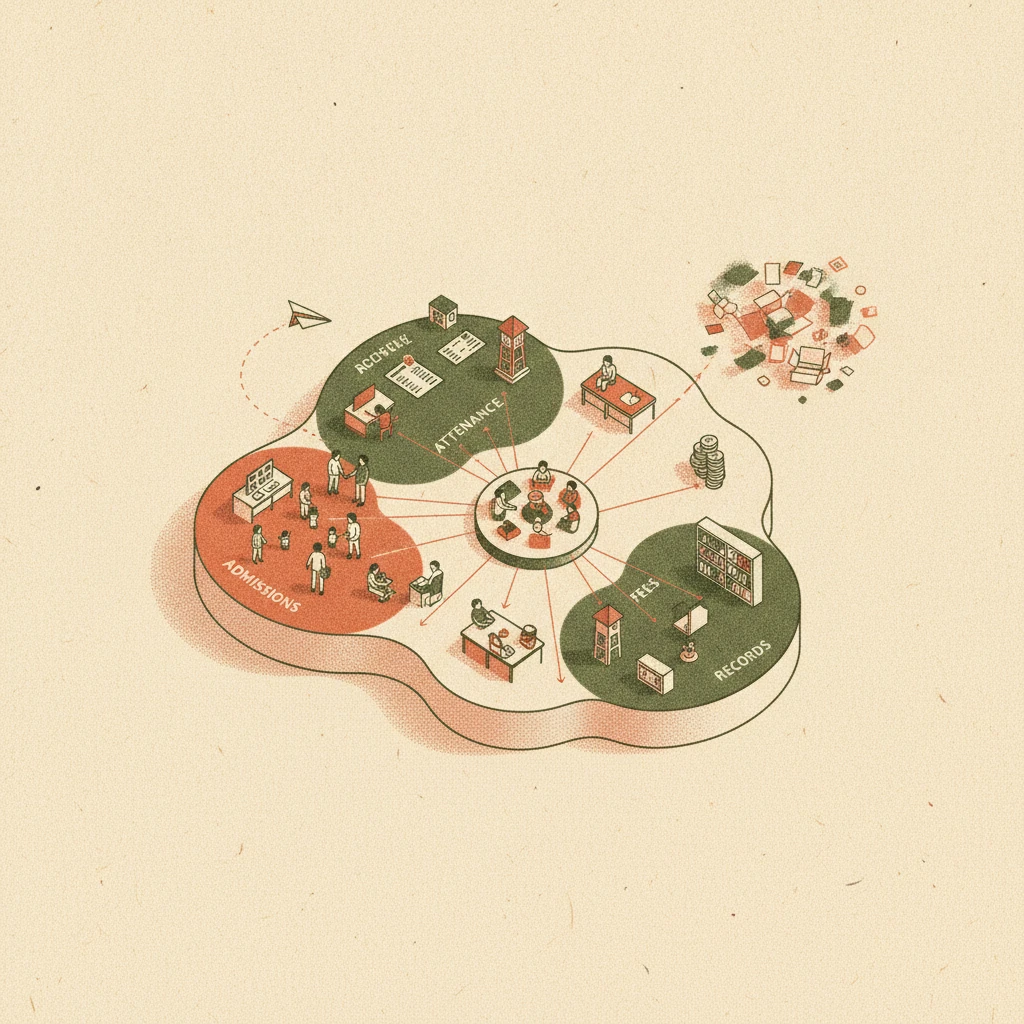
Watch how tools pile up in an immature school. A spreadsheet for fees. A separate one for attendance. A WhatsApp group for parents. A paper file for admissions. A different app for staff. Each one was added to solve a single problem, and together they created a bigger problem, because none of them talk to each other.
The mature move is the opposite. Consolidate rather than accumulate. Instead of five disconnected records that quietly disagree with each other, you keep one connected system where the same child’s attendance, fees and file are the same record everywhere.
This is the practical case for preschool management software that keeps one shared record rather than many private ones. Larger schools sometimes describe the same idea as preschool ERP software, one back-office system that ties admissions, fees, staff and reporting together instead of leaving them in separate apps. Whatever the label, the goal is the same. An all-in-one preschool management solution is simply one place where the numbers agree, so nobody spends Friday deciding which spreadsheet to believe.
Why does consolidation actually help? By mechanism, not magic. Every extra disconnected copy of your data is one more place an error can hide, and one more version that can drift out of date. Fewer sources of truth means fewer disagreements to reconcile. That is the whole argument. It does not need a saves X percent figure, and there is not an honest one to give.
An honest caveat: consolidating is not free. It takes a week or two to move records over and get staff comfortable with the new habit. The payoff is that the reconciliation work shrinks. It does not vanish overnight. The hidden coordination work behind a smooth day is exactly what a connected system absorbs, so a person no longer has to carry it alone.
They decide on signals, and every decision has an owner
Two habits mark out mature decision-making. Decisions rest on real numbers, and each decision has a clear owner.
Decide on numbers you track yourself
Mature schools track a few numbers themselves instead of guessing. You do not need many. Start with these:
- Occupancy: seats filled versus seats available, per room.
- Fee collection speed: how long, on average, between a fee falling due and the money arriving.
- Overdue balance: how much is outstanding right now.
That middle number has a proper name. Borrow Days Sales Outstanding, or DSO, the average number of days it takes to turn a billed fee into cash in the bank. The mechanism is plain. A high number means money is sitting uncollected and cash is tight. A low number means collection is working. This is how you talk about fee leakage honestly, not with an invented recovery percentage, but with a number the school can measure on its own accounts and watch move over time.
Follow the logic. If a school never measures how long fees take to collect, it cannot know it has a collection problem until the cash runs short. Measuring it turns a vague worry into a number you can act on this month. And schools that decide on data rather than gut feel tend to run measurably better than similar schools that do not. Treat that as a direction of travel, not a promise.
Read More: The Preschool Management Signals That Tell Owners Their School Is Truly Organized
Give every task and number a named owner
In a mature school, every recurring task and every number has a named person responsible for it. Admissions follow-up. Overdue fees. Incident reports. The clean way to set this up is role-based access, where responsibilities are attached to a role, front desk, teacher, principal, rather than handed out one person at a time. Access matches the job, so ownership is obvious, and nothing falls through the gap between two people who each assumed the other had it.
This is the antidote to the quiet cost of delayed decisions. When someone owns a number and can see it live, the decision happens in a day instead of a month.
The maturity self-assessment you can run this week
You do not need software or a consultant to find out where your school sits. You need about twenty minutes and honest answers. Ask yourself these six questions.
- If your most senior staff member were away for a week with no notice, would admissions, attendance and fee reminders still happen correctly?
- Is there one shared record where a child’s attendance, fees and file all agree, or do you keep separate lists that need reconciling?
- Can you say, right now, without asking anyone, how many seats are empty and how much fee is overdue today?
- When a fee is missed, do you find out within a day, or only at month-end?
- Does each recurring task, follow-ups, overdue fees, incident reports, have one named owner?
- Are your core routines written down anywhere a new hire could actually follow them?
Mostly no means you are early on the curve. Mostly yes means you are already mature and should be tuning what you have. There is no shame in early scores. Most schools start right there. The point is to see the specific gaps, not to grade yourself.
Then take a first step that carries almost no risk. Do not rip everything out at once. Pick the one no that costs you the most, usually fees or attendance, and fix only that. Write the routine down. Put it in one shared place. Give it an owner.
Read More: What Makes an All-in-One Preschool Management Solution More Effective Than Multiple Tools
Make improvement a loop, not a one-off. The reliable way to get better is a small repeating cycle. Look at the Plan-Do-Study-Act cycle: plan a small change, do it, study whether it actually worked against what you expected, then adjust and keep the part that worked. In practice that looks like this. Change one fee-reminder step. Watch the overdue number for a month. Keep the change if the number moved, and try something else if it did not. Maturity gets built one repeated loop at a time, never in a single grand overhaul.
You can start the first loop before the children arrive on Monday.
A quieter measure of a good school
Stop measuring your school by how hard you personally work to hold it together. Measure it by how well it would run if you stepped back for a week.
Operationally mature preschools are not the ones with the most heroic owners. They are the ones where the routines are written down, the records agree, the numbers are visible, and every task has an owner. That is what lets a school grow without the owner’s Friday evenings growing along with it.
So run the six questions this week. Fix the one gap that costs you the most. Then run the loop again, and again after that. The calm you are looking for does not come from working later. It comes from building a school that no longer needs you to.
FAQ
It means your school does the same things the same way no matter who is on shift. Admissions, attendance and fee reminders run from written routines and one shared record, so the school keeps working even when the owner or a senior teacher is away. Maturity is about repeatable operations, not how busy or hands-on anyone looks.
A well-organized school can still depend on one person keeping everything straight in her head. That is fragile. A mature school has moved those routines out of memory and into shared, written processes that anyone with the right role can follow. If your school would stall after a single resignation, it is organized around a person, not yet mature.
Systems help, but maturity comes first. The foundation is repeatable, shared processes and one record everyone trusts. Software makes that easier to keep consistent and visible, especially as a school grows, but installing an app without agreed routines just moves the mess into a new tool. Fix the process, then let the system carry it.
Run the six-question self-check, then pick the one gap that costs you the most, usually fees or attendance. Write that routine down, put it in one shared place, and give it a named owner. Watch a single number, like overdue fees, for a month, and keep the change if it moves. Small repeating loops build maturity over time.
Related posts
- September 14, 2026
- 7:59 am
The Cost of Decision Delays in Preschool Management

- September 10, 2026
- 7:58 am
Why Preschool Owners Need a Management System That Works Beyond Individual Employees

- September 7, 2026
- 7:58 am
